HomeQube
Missions communities declare anyone can watch
- 1 Watch free
- 2 Wish or start a mission
- 3 Machines help close
Built Environment Machines. Outcomes beyond homes.
Watch free. Wish or start a mission. Machines help close.
For people · society door
You don’t bring a machine. You bring a mission.
Open a Small World and declare what should exist — a home, a well, a workshop.
The wishlist is the mission board. Machines and people match to it; you watch the gap close in the open. When the mission closes, it settles — proof, not promises. You don’t need a machine to enter.
Start a mission → Open a public Small World → What are outcomes / wishes? →
The map · one glance
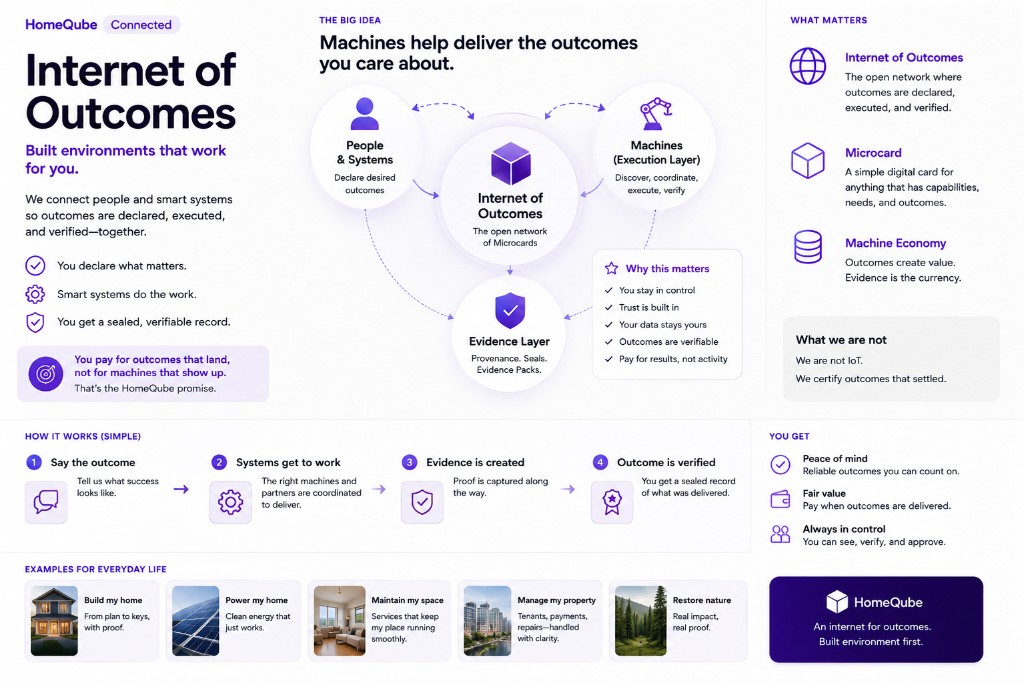
Internet of Outcomes — declared, executed, verified
People declare what should exist. Machines help close it. Evidence settles the record — not activity for its own sake.
Be a mission creator
Start a mission. Be the creator.
Declare what should exist. Others wish into the pot; machines help close. Watching stays free.
Your declare
- 01 Declare — open a Small World; say what should exist (a home, a well, a workshop). No machine required.
- 02 Locate — your mission takes a place on the field; the wishlist is its mission board.
- 03 Gather — wishes join the pot; machines and people match to it. One number, one shape — it drains as work lands.
- 04 Close — the mission settles with proof. Watching was free the whole way; settlement is the receipt.
As a founder you see your pot as one number and one shape — who wished, what matched, what closed.
Mission it — open your world → Founding a mission? Request a founder brief (email) →
This porch teaches. Activation is on homeqube.tech — no machine required. Vocabulary: Mission → Wish → Pot → Close.
Internet of Outcomes · by example
Missions communities can run
Housing pots, energy access, fab cells, rebuilds — missions communities can close with evidence.
- Starter home on an empty lot — family declares rooms; fabricators + fund close it.
- Typhoon-ready rebuild — stronger envelope, same address, open proof.
- Barangay water point — pump, tank, tap; neighbors wish maintenance.
- Neighborhood fab shed — shared CNC / printer; “I need a bracket” is a wish.
- Community laundry shed — machines Alive; schedule and uptime on the board.
- Barangay clinic annex — exam room + pharmacy shelf + ambulance bay.
- Rooftop solar for the compound — offtake and bill-share as the wish board.
- Repair café — broken appliances wish themselves fixed; makers answer.
Built-environment first — worlds you can wish into today. Watching is free. Settlement is the proof.
Watch · porch demos
See a mission gather — before you join
Two short clips — one machine joining a mission, then the field thickening. Live Camera is on homeqube.tech. No login here.
Leaf path · ~75 seconds
One machine joins the mission
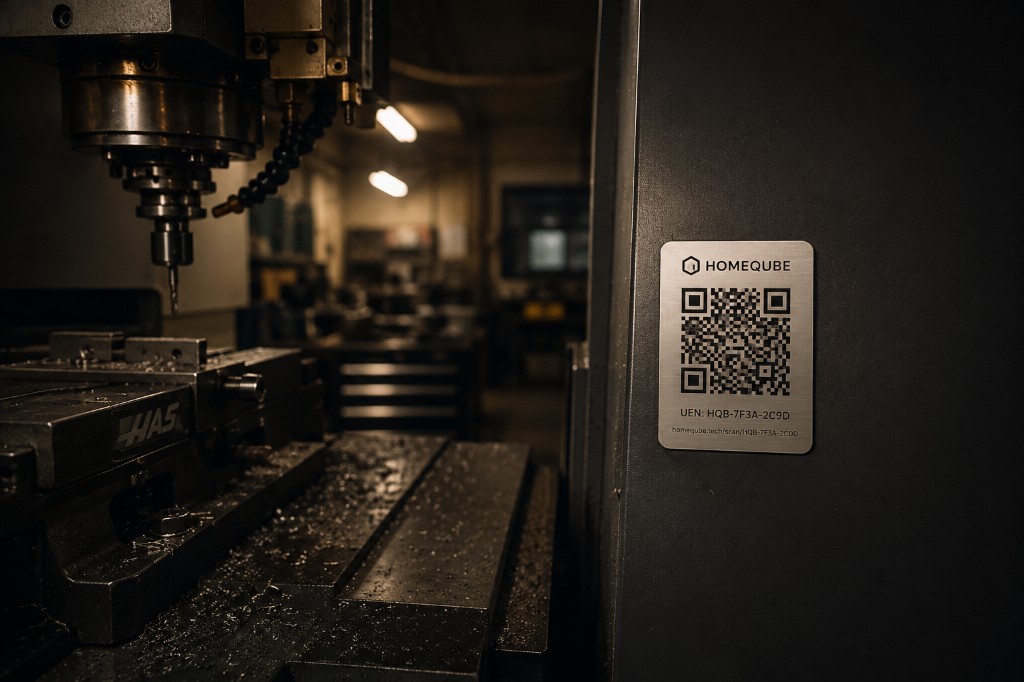
From QR sticker to Alive on the network in ~75 seconds — then a wish steers what it helps close.
Field · ~13 seconds
The mission gathering mass
Every tick is real work by someone’s machine — and anyone can watch.
For operators · optional
Have a machine? Put it on the wire.
Physical AI starts with machines that can join a network — Built Environment first; outcomes beyond homes. One address, one stamp, one trusted heartbeat — Alive.
CNC, robot, PLC, printer, legacy shop floor — same door, regardless of manufacturer or software. Websites are for people. Microcards are for machines.
Bring a machine (Alive) → Operator brief (email) →
How the rails work · open banking for machines
Open Banking let money move across institutions without each pair building a private pipe. HomeQube applies that pattern to physical machines: one network address, one stamp, one trusted heartbeat — then Alive on the wire. On homeqube.tech: Camera looks · Console composes — same Small World, not a second product.
What “online” means here
- 01The machine gets a permanent network address
- 02QR stamped on the physical thing — address on the object
- 03A trusted heartbeat → the node is Alive (digitally connected)
- 04Anyone can open its page without an account
- 05Richer integrations later — optional now
How a Microcard gets a signal
- 01 Address + QR — Microcard address; QR is the stamp surface. Not yet Alive.
- 02 Trusted heartbeat — phone, smart plug, gateway, or API. Same Alive outcome.
- 03 Richer later — native API, autonomous agent. Upgrades, not the door fee.
APIs are one heartbeat source — not the definition of a connected machine. Legacy equipment stays in.
What happens next · partner brief
- 01You request a connection — short form, human review
- 02We hold a brief — partner, not training
- 03You mint on the main site: Add → Stamp → Heartbeat
- 04Your machine page is the close — Alive, signal on the socket
This isn’t a software tour. First connection — like bringing a host onto a new internet.
Who we’re bringing online
Early nodes
Communities declaring missions — and shop owners who put a real machine on the wire (CNC, printer, co-op equipment) so those missions can close with proof.
We won’t mint synthetic cards for optics, sell a dashboard tour, or ask you to learn consoles first.
After a node is Alive, wishing is how the mission finds its people and machines.
Seeking — first living nodes not published here yet.
Evergreen · old interviews
Earlier conversations, still on the wire
Long-form context — not a product tour. Built Environment Machines, then the rails.
-
Breaking Ground PH · YouTube
Innovating Housing Solutions: JP Calma’s Vision for the FutureEarly interview on housing innovation — why identity and coordination come before another dashboard.
FAQ
Missions, machines, briefly
I don’t own a machine. Is this for me?
Yes. Watching a Small World is free and needs no account. Declaring a wish is how a mission starts — machines are the execution layer, not the membership fee.
Search finds, AI answers — what does HomeQube do?
Search finds. AI answers. HomeQube closes. Searching and asking are prior eras; missions close real-world results with evidence. Don’t search it. Don’t ask it. Mission it. Learn the Internet of Outcomes →
Is HomeQube only for homes?
No. Built Environment Machines. Outcomes beyond homes. The name is a beachhead; the category is Physical AI Infrastructure — Built Environment first, then every machine that closes an outcome. Learn the Internet of Outcomes →
What is the Coordination Grid?
The Grid is a universal coordination substrate. A Microcard is the coordination socket — not an energy socket or a housing socket. Domains (energy, housing, logistics, robotics, finance) are applications on that substrate. Distributed evidence closes Missions.
How does this relate to civilizational coordination?
Kardashev measures energy. The Civilizational Coordination Scale measures how much reality we can reliably align toward verified shared outcomes. Missions on this porch are closed coordination events — not posts, not carts. Read the framework essay →
What do I actually get?
A closed outcome with proof — a home, a workshop, energy access, a fab cell — and the ability to watch it emerge instead of trusting a private promise.
Why should a community care?
Because coordination is the expensive part of building. Small Worlds make who-does-what visible — bayanihan, with receipts.
What does it take to start a mission?
Open a public Small World and declare what should exist. No machine, no fee to try. Your mission becomes a wish board others can join — Mission → Wish → Pot → Close.
What if my mission doesn’t gather?
Nothing is charged and nothing is faked. The pot arithmetic is honest — seed wishes are marked and add no mass. A quiet pot is visible truth, not a hidden failure.
What does the founder get when the mission closes?
The outcome itself, settled with proof, and the visible record of having convened it — who wished, what matched, what closed. Watching was free the whole way; settlement is the receipt.
Websites are for people — what are Microcards for?
Websites are for people. Microcards are for machines. Humans discover services on this porch and homeqube.tech; machines discover capabilities on living Microcards — address, stamp, heartbeat at /scan/:uen.
What is Machine Identity?
A permanent network address for a physical machine — issued as a QR Microcard — so it can join shared coordination rails regardless of manufacturer or software.
What does Alive mean?
Stamped identity plus a trusted heartbeat (phone, smart plug, gateway, or API). That is the v1 done-when for connecting a machine to the network.
Do I need an API or OEM integration first?
No. APIs are one heartbeat source — not the definition of a connected machine. Legacy equipment stays in.
What is Physical AI Infrastructure here?
Rails so real machines can participate: identity, Alive heartbeat, then coordination toward outcomes — built environment first. Domain gradients densify at /protocol/. Open banking for machines is how those rails work — shared pipes, not another app.
How do I connect my first machine?
Request a connection from this porch, complete a short partner brief, then mint: Add → Stamp → Heartbeat. Your public machine page is the close when Alive.
Is Connect a third product?
No. Connect is where you learn identity first. Then Add a machine (Alive) or Watch a Small World on homeqube.tech — both meet in the same Small World.
Does every machine need its own always-on server?
No. Microcard identities stay addressable and idle until Speak / heartbeat. That is the protocol shape — not a claim that HomeQube’s whole stack is serverless.
How Machine Identity works — Add, Stamp, Heartbeat →
Why construction robots still fail on real sites →
What does Alive mean? — signal on the socket →
What are machine outcomes? (not add to cart) → One Microcard Harness · domain gradients (vision) →
Entity depth on homeqube.tech: Machine Identity · QR Microcard · Emergence OS · Mission creator · Mission pot